

Why you’ll deep clean the oven...tomorrow
Plus, what makes us regret one-night stands?
BRAIN WAVES
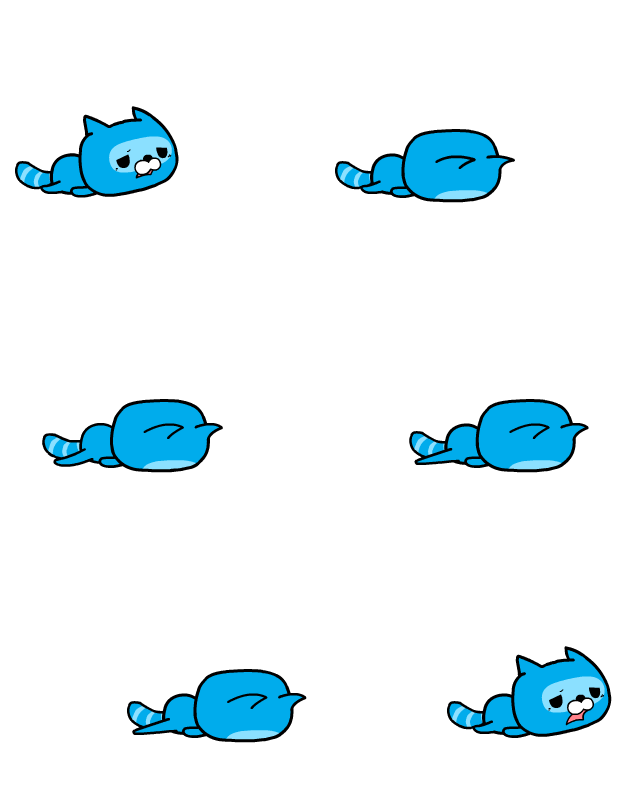
To do(n’t). We all know that unpleasant tasks are, well, unpleasant. But our tendency to avoid them may be rooted in the brain, not just in a lack of willpower. A new study looked at the neurobiology behind why we put off things like cleaning the fridge or writing a complicated email. Researchers gave macaque monkeys simple tasks that ended either with a reward or with a reward plus an annoying puff of air to the face. As expected, the monkeys avoided the task that came with the annoying puff. But when scientists manipulated two of their brain regions — regions associated with motivation – that same hesitation vanished. The monkeys went ahead with the task even when they knew the puff was coming, suggesting that this circuit acts like a built‑in motivation brake. In other words, our reluctance to do unpleasant things isn’t just laziness; it’s part of how the brain weighs cost and discomfort before taking action.
Wham, bam...How do people look back on their one-night stands? Researchers surveyed over a thousand people from more than 40 countries. They asked them to look back on their most recent one-night stand and rate everything from sexual satisfaction to alcohol intoxication to how autonomous their decision felt. They found that most people, regardless of gender, felt neutral to positive about their experience. But there was a gender gap. Women tended to regret the experience more than men, at least when it came to opposite-sex one-night stands. What explains the gap? Decision pressure, reputational worries, and heavy intoxication all played a role, but sexual satisfaction was the biggest culprit. That same gender gap didn’t seem to exist in same-sex encounters. “Gender differences in sexual experiences remain robust even when controlling for substance use,” the study concluded.
The horror...Why are so many of us drawn to horror, gore, and true crime? Why do we crane our necks to see the scene of a crash on the highway? Listen to learn more.
ON THE HIDDEN BRAIN PODCAST
Group Think: How do the groups you identify with shape your sense of self? Do they influence the beer you buy? The way you vote? In this favorite episode from 2021, psychologist Jay Van Bavel explains how our group loyalties affect us more than we realize, and can even shape our basic senses of sight, taste and smell. Then, look out! There’s a g-g-g-ghost! Psychologist Coltan Scrivner answers listener questions about the surprising benefits of scary entertainment.
ON THE MY UNSUNG HERO PODCAST
Holly Deiaco-Smith’s Story: After a few weeks of studying abroad in France, Holly felt overwhelmed and homesick. But an encounter with a stranger at the post office changed everything, and led to a decades-long friendship.
Don’t forget to send us the story of your unsung hero! Record a voice memo on your phone and email it to myunsunghero@hiddenbrain.org.
MIND GAMES
When you stop to look, you can always see me. But if you try to touch me, you can never feel me. Although you walk towards me, I remain the same distance from you. What am I?
LAST WEEK’S PUZZLE
There are three boxes. One contains only apples, one contains only oranges, and one contains both apples and oranges. The boxes have been labeled incorrectly, and no label correctly identifies the contents of its box. You must open just one box and take out one piece of fruit without looking at the contents of the box. By looking at the fruit you’ve picked, how can you label all of the boxes correctly?
The answer: The box labeled Apples and Oranges contains only one or the other, since it’s mislabeled. Pick one fruit from that box. If it’s an orange, then label the box as orange. Then you’ll know the box that’s labeled Oranges actually contains apples, and the remaining box contains both.
A MOMENT OF JOY
A simple act of kindness — plus, soup

This weekly newsletter is made possible in part by Loom by Atlassian. Unstuck your process, projects, and teams with video communication from Loom. It’s a team changer. Try Loom today at loom.com.
Have an idea for Hidden Brain? A story you want to share with us? Send an email to ideas@hiddenbrain.org. Listen to us on Spotify, Apple, Amazon Music or your favorite podcast platform.