

Can anger be a motivator?
Plus, the socially anxious brain
BRAIN WAVES
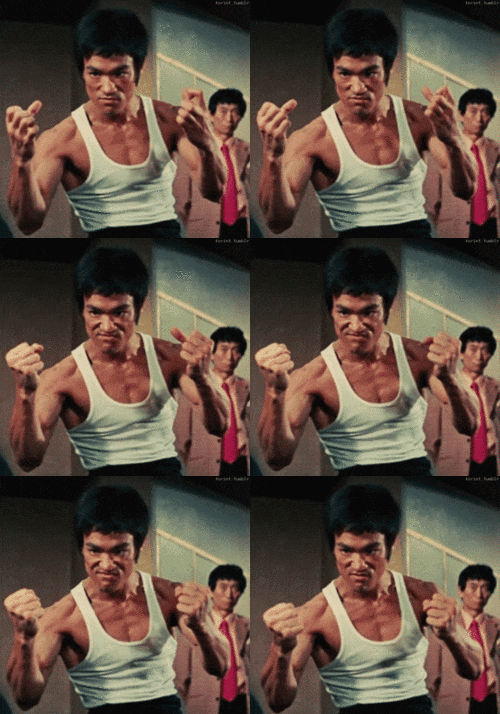
Get mad. No one likes being angry — well, maybe some of us — but as unpleasant as anger can be, there are times it can also be useful. A study set out to test whether anger might help people reach their goals when certain obstacles are in the way. Across seven experiments, researchers induced anger using different tasks, or images (one of the images included an angry person pointing, for example). Then they measured how people performed on various challenges, like solving hard puzzles, playing video games, and even voting in contentious elections. The results showed that angry participants often persisted longer on a task, reacted faster, and took more decisive action compared to people in neutral states. In short, anger seemed to sharpen focus and boost effort. Like a Swiss Army knife, the study reported, “different emotions are best suited to solve specific problems.”
Crowdsourcing. What drives social anxiety? A study looked at whether social anxiety changes how people perceive others approaching, both individuals and in crowds. Researchers used an animation technique to simulate someone walking, then asked the study subjects to track where they thought the people were moving. More anxious participants consistently judged walkers — even those angled away from them— as coming straight at them. They extended this bias to crowds, too. In other words, social anxiety makes you see the world differently and might even make the world feel more threatening than it really is.
Money problems. We like to think that good financial decisions come down to discipline and basic math. But the psychology of money turns out to be deeply complicated. Listen to learn more.
ON THE HIDDEN BRAIN PODCAST
How to Combat Pain: Pain feels like a simple message from the body. If your elbow hurts, there must be something wrong with your elbow. If your back is painfully stiff, you need some work done on your back. But psychologist Rachel Zoffness says our minds play a much larger role in our experience of pain than many of us realize. This week, we look at what’s really happening when we experience pain, and how a better understanding of this process can open up new possibilities for treatment and healing.
ON YOUTUBE: THE COMPARISON GAME
Why do we compare ourselves to others, and what effect does this have on our lives? In this video, we explore the psychology of social comparison — both upward and downward.
MIND GAMES
What do the letter “t” and an island have in common?
LAST WEEK’S PUZZLE
A dad is 42 years old, and his son is 6. So, in how many years will the father’s age be four times his son’s age?
The answer: In 6 years, the Father will be 48, and the son will be 12, making 42 = 4 × 12.
MOMENT OF JOY
Have an idea for Hidden Brain? A story you want to share with us? Send an email to ideas@hiddenbrain.org. Listen to us on Spotify, Apple, Amazon Music or your favorite podcast platform.