

A benefit of starting childcare sooner
Plus, remembering names
BRAIN WAVES
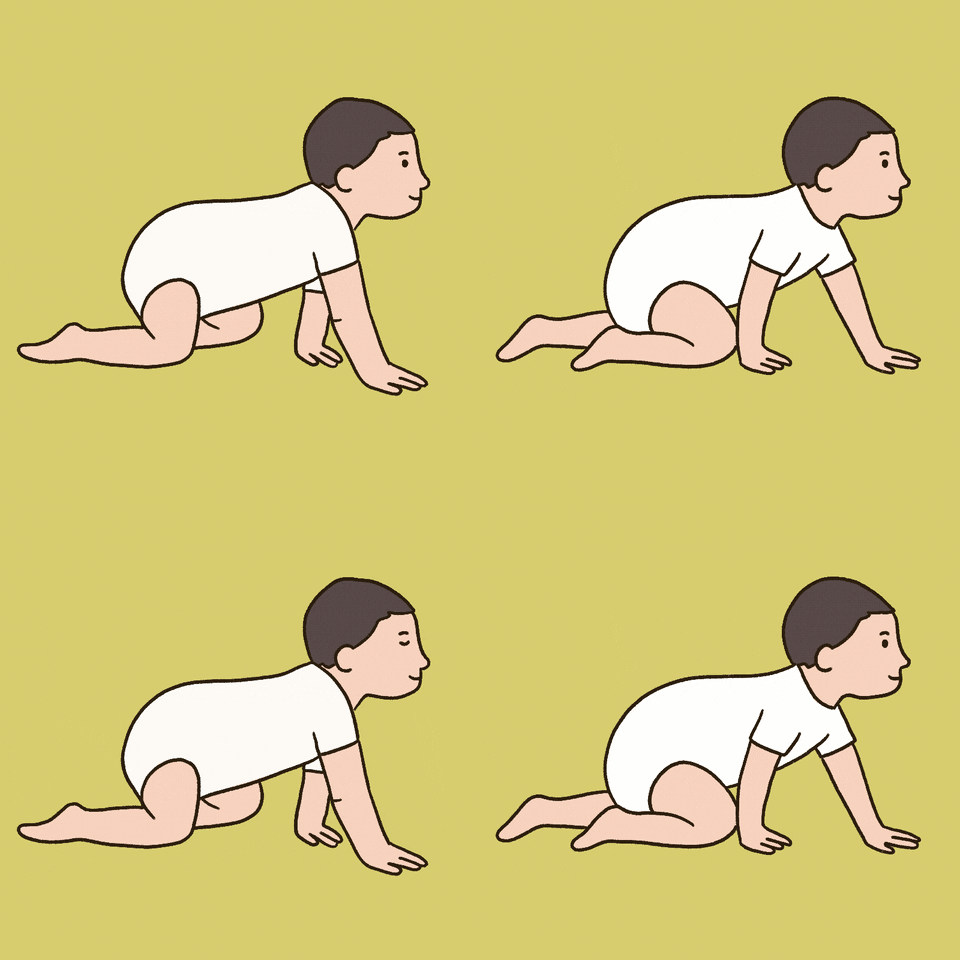
Baby steps. How big of a difference does daycare make? Researchers wanted to know whether starting formal childcare a year earlier (at a licensed, registered daycare center, as opposed to being cared for by family at home) might affect a kid’s academic performance later in school. To test this, they took advantage of Norway’s 2003 childcare expansion, in which towns were required to expand childcare spots. But the expansion rollout was uneven: some towns expanded faster than others. Thus, some babies got a daycare spot at one year old, while others had to wait until age two, depending on where they lived. Then the researchers linked national registry data for every child born between 2002–2007 to their later standardized test scores. They also looked at when each child started daycare. They found that starting childcare one year earlier boosted ninth grade math scores by a few percentage points. For children whose mothers didn’t finish high school, the improvement was much larger — roughly the difference between being an average student and an above‑average one. The study suggests that high‑quality early childcare can reduce some achievement gaps, especially for kids who might start out with fewer advantages.
That’s a shame. Some faces (and paintings) are more memorable than others. This is something researchers call “memorability” — an intrinsic quality that makes some things more likely to stick in our minds. Researchers were curious if a memorable face might make it easier for someone to remember your name. Across a series of experiments, psychologists Andrew Cook and Deanne L. Westerman found that the more memorable a person’s face, the better able volunteers could recall their name, even when they couldn’t see the face. Interestingly, though, researchers also looked at the same question with cities and scenery, and the effect did not hold. People remembered the scenes, but not the names of the cities associated with them. It seems “our brains have a special connection between faces and names,” as Cook put it.
Mind on my money. We like to think that good financial decisions come down to discipline and basic math. But the psychology of money turns out to be deeply complicated. Listen to learn more.
WHY WE MELT DOWN UNDER PRESSURE — AND HOW TO STOP
You spend hours studying for the big test, practicing for the concert, prepping for the job interview. You feel ready. But when that big moment finally arrives...you choke. Why does this happen, and how can we keep our own minds from sabotaging us? Check out this video on our new YouTube channel to find out.
HIDDEN BRAIN LIVE
Experience Hidden Brain Live at Stanford on Saturday, May 16. A decade of discovery, distilled into one unmissable event. Stanford alum and Hidden Brain host Shankar Vedantam is bringing his signature science and storytelling to the stage to share the insights that have captivated millions—and might just change how you see yourself.
ON THE HIDDEN BRAIN PODCAST
Radical Acceptance: Last week, we looked at the hidden beliefs that can leave us feeling stuck in life. This week, in the second part of our conversation with behavioral scientist Dave Evans, we talk about radical acceptance. Dave shares why accepting reality as it is can be so difficult — and why it’s an essential first step in building a meaningful life. Then, in the latest installment of Your Questions Answered, psychologist Sarah Schnitker returns to answer listeners’ questions about patience.
ON THE MY UNSUNG HERO PODCAST
Barb Barnes’ Story: After having open heart surgery, Barb was terrified of the immense pain she’d likely have to endure during her recovery. Then a nurse stepped in to help and changed the rest of Barb’s life in the process.
Don’t forget to send us the story of your unsung hero! Record a voice memo on your phone and email it to myunsunghero@hiddenbrain.org.
MIND GAMES
Two people have $100 in total. One has $40 more than the other. How much does each have?
LAST WEEK’S PUZZLE
I am a number, but when you add ‘G’ to me, I go away. What number am I?
The answer: One
MOMENT OF JOY
Have an idea for Hidden Brain? A story you want to share with us? Send an email to ideas@hiddenbrain.org. Listen to us on Spotify, Apple, Amazon Music or your favorite podcast platform.